Nature Religions
Nature Religions
Alongside the major religions in Finland and around the world, many other kinds of religion are actively practised. Some of these are nature religions. They are no less genuine than the dominant religions, even if many are not officially recognised within national religious systems.
Nature religions encompass many paths of belief, united by their respect for nature and the central place it holds. The religions practised before the arrival of Christianity are also commonly described as nature religions, since they were almost invariably rooted in nature. Shamanism is one example, although many ancient religions have no distinct name today.
Nature religions can differ greatly, from dualistic belief in two deities to henotheism, with one principal god and several subordinate gods, and polytheism, with many deities of equal standing. Yet they share many features too, including similar kinds of gods whose names vary from culture to culture.
Nature religions have had a relatively weak position in Finland, despite having thousands of practitioners. Attempts have been made to obtain official recognition for some of them, but these have encountered prejudice and difficulties relating to the absence or ambiguity of foundational religious texts.
According to the account of Finland’s religious system given here, official religions have been expected to have a foundational text, such as the Christian Bible, the Islamic Quran, or the Jewish Talmud. Few nature religions have such texts, partly because their roots reach back to times when recording beliefs in writing was not always possible or considered necessary.
Nature Religions in Finland
Several kinds of nature religion are practised in Finland today. Depending on the tradition, their roots may lie in Celtic, Germanic, or Scandinavian cultures. Many modern forms of paganism, however, draw on a mixture of cultural traditions.
Here we present some of the more common nature-religious paths found in Finland. The list is by no means exhaustive.
Traditional Nature Witchcraft
By Traditional Nature Witchcraft, we mean polytheistic witchcraft with roots in Finnish shamanism and Celtic culture, without a distinct name of the sort used by other nature religions described on these pages. It has no single foundational book or binding rules; the path takes shape through its practitioner. Respect for nature and tradition, honouring many gods, celebrating sabbats, healing, and divination are central to it.
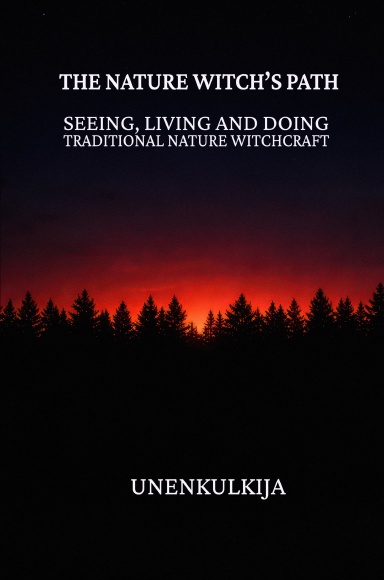 The Nature Witch's Path
Seeing, Living, and Doing Traditional Nature Witchcraft
Language: English — hardcover edition.
Discover The Nature Witch's Path, a personal exploration of traditional nature witchcraft.
Written by Unenkulkija, founder of Varjojen Kirja.
Traditional nature witches observe sabbats, seasonal festivals also known from Druidry and shamanism. Each sabbat has a particular meaning and is celebrated accordingly. Samhain, for example, marks the end of summer and the beginning of the darkest part of the year, while honouring the dead. A place may be set at the feast for the departed, and a continuous protective, guiding flame may be kept burning from Samhain evening until Yule.
Traditional nature witchcraft respects nature as it is and the divinities found within it. In this view, each element — fire, earth, air, and water — has both masculine and feminine divine aspects, sometimes addressed as Father and Mother Earth. Other fellow inhabitants of the world are also honoured, including the folk of the earth, water, forest, and air, as well as spirits, fairies, and haltijat, the guardian beings of Finnish tradition.
A person following traditional nature witchcraft may have an altar at home for quiet reflection or may sit inside a ring of candles to meditate. Kitchen witchcraft, herbs, healing, divination, conservation, volunteering, and other forms of caring for others may be important to a nature witch. None is compulsory. What matters most is what you feel within yourself and how you treat nature and your fellow living beings.
Asatru (Aasainusko)
Ásatrú, or the faith of the Æsir, is a modern pagan nature religion based on the ancient Scandinavian religion of the Viking Age. Its roots lie in the mythology preserved in the Norse Eddic poems. Modern Ásatrú emerged in Iceland, where it has enjoyed official religious recognition since the early 1970s.
Ásatrú is polytheistic: it honours many gods and goddesses. The deities are chiefly divided into two families, the Æsir and the Vanir. The Æsir are associated with warriors, while the Vanir are linked with nature and fertility. Familiar deities include Thor, god of thunder; Odin, god of war and wisdom; and Freyja, goddess of love, beauty, and battle. In this account of Ásatrú, the gods and humans are understood as equal in worth.
In Ásatrú, the nine worlds — Midgard, Asgard, Vanaheim, Alfheim, Nidavellir, Jotunheim, Svartalfheim, Niflheim, and Muspelheim — are bound together by Yggdrasil, the world tree. Humans dwell in Midgard, the Æsir in Asgard, and the Vanir in Vanaheim.
An important aim of Ásatrú is to live a meaningful and good life. Individual freedom matters, but so does responsibility. Your actions have consequences, and you must take responsibility for them. Rather than a fixed list of written prohibitions, the emphasis lies on acting freely but with moderation and accountability. Human beings are believed to have some influence on their fate within the span of life allotted by the Norns.
According to this page, Ásatrú has no dedicated official association in Finland, although information and like-minded people can be found online.
Druidry
The Druids were the keepers of knowledge in Celtic culture, and Druidry is rooted in their traditions. Its history stretches far back. The original form is understood to have disappeared long ago amid the spread of Roman power and Christianity, but, like many nature religions, Druidry has returned as circumstances have become more favourable.
Important aspects of Druidry include the Wheel of the Year, a calendar beginning with Samhain on 31 October, and a great number of deities, traditionally grouped in this account as tribal gods, warrior gods, and earth goddesses. More than three hundred different deities have been estimated.
This account places the origins of ancient Druidry around 1000–500 BCE and its decline during Roman expansion and the spread of Christianity. The revival of modern Druidry in England in the 1960s is one reason it is sometimes regarded as a modern pagan religion.
Druids celebrate the Celtic seasonal festivals: Samhain, the new year; Imbolc, the beginning of spring and a festival of nature’s awakening and fertility; Beltaine, a spring festival around May Day; and Lughnasa, the harvest celebration. Nature and its elements — earth, air, fire, and water — have always been important in these festivals. The Wheel of the Year also includes four smaller festivals at the solstices and equinoxes.
Modern Druidry differs from ancient Druidry in a number of ways, including the participation of women. Whereas the original tradition is described here as male, modern Druids can be women as well. Many men still practise Druidry, and its gender distribution may be more balanced than in some other modern nature religions.
Feri Tradition
The Feri tradition is a polytheistic, modern pagan nature religion originating in the United States. It shares features with other nature religions, placing particular importance on the practitioner’s soul and the spiritual powers believed to develop over time.
The American Victor Anderson is regarded as one of the founders of Feri. He was described as a powerful shaman who viewed Feri as a primal religion, comparable in certain respects to Vodou and present throughout history.
Feri has no single foundational text. Its traditions have been passed from person to person, changing to meet practitioners’ needs, much as Victor Anderson himself taught them to his students.
Feri practitioners are described here as believing that humans may become fairy-like beings through spiritual growth. They believe in the union of souls and the Star Goddess. Although Feri is polytheistic, its emphasis on the Goddess is strong enough for it to be considered, in some respects, henotheistic: one central deity alongside others. The Holy Twins and the Blue God are children of the Goddess.
Although Feri shares much with other nature religions, it has distinctive ideas such as the Black Heart of Innocence and the Blue Feri Fire. Contrary to a common misunderstanding, Feri is not simply another form of Wicca, but a tradition of its own.
"Finnish belief"
Suomenusko is a polytheistic faith grounded in Finnic mythology, developed over many centuries and millennia. It places nature, Finnish deities, the ways of ancestors, and the spiritual landscape of Finnish tradition at its centre.
Among its important places are natural sacred sites used for hundreds of years, such as springs, groves, and stone cairns. Traditional celebrations include helavalkeat, springtime fires; Kekri, an autumn feast; and Karhunpäivä, a day associated with the bear. Honouring the bear has long been part of Finnish culture.
Suomenusko also gives great importance to the spirits of the dead, gods, and haltijat, and to the belief that everything has a soul, whether stone, star, or animal. In this worldview, life does not end with death: the soul passes to Tuonela after the body dies.
Many people have encountered the gods and figures of Suomenusko without realising it: Väinämöinen, described here as a water deity, healer, and keeper of knowledge; Ukko, god of sky and thunder; Louhi, Mistress of the North; and Ahti, a god and ruler of the waters and their folk. Guardian spirits such as the saunanhaltija and kodinhaltija may also be familiar from the stories of older generations.
Finnish culture has a strong tradition of verse, myth, and incantation. The Kalevala, Finland’s national epic, holds an important place among followers of Suomenusko. In this tradition, even stones, stars and animals have souls, and death is understood as the soul’s passage to Tuonela.
Voodoo
Vodou, also spelled Voodoo, is described here as one of the most widespread nature religions with shamanic influences, practised especially in Africa and the Caribbean. It has a particularly strong presence in Haiti, where this account says that as many as 90 percent of people practise Vodou and where it has enjoyed official religious status since 2003. Vodou has many branches with distinctive features, so only the broadest points shared across traditions are discussed here.
Healing is a central part of Vodou, along with the work of priests known as houngans and ritual specialists sometimes called bokors. In this account, the houngan is associated primarily with healing and benevolent purposes, while the bokor may also know magic connected with curses. This does not necessarily make the bokor evil: a different kind of magic can also be used to help others. Much depends on the person practising it.
Zombies have an important place in stories about Vodou, although not quite as films and books portray them. This account describes a belief that a priest can turn a person into a “zombie” by using a substance that slows bodily functions and produces a coma-like state, with a bokor then able to restore the person by administering an antidote.
The divinities honoured in Vodou are described here as ancestral spirits close to the gods or as deities from African mythologies. However they are understood, gods and spirits are treated with deep respect. As in many shamanic worldviews, stones, plants, and other parts of nature are regarded as alive or inhabited by spirits, and sacred places exist in the natural world. Contrary to popular misconceptions, Vodou is not chiefly about dolls pierced with needles or so-called black magic.
Shamanism
Shamanism may be among the oldest forms of religious life, with traditions found around the world for as long as humanity has existed. Cultures differ greatly, but recurring features include reverence for nature, working with natural forces, contact with the spirit world, and healing.
Shamans have served, and in many communities still serve, as healers, seers, keepers of knowledge, and people experienced in working with spirits. Depending on the culture and community, there might be one shaman or several. Where several were present, they often had different strengths: one might be a healer, another a seer, and another particularly skilled in dealings with the spirit world.
Today, shamans do not necessarily occupy the same communal position as in earlier times. Within their own families, circles, and communities, however, contemporary shamans may still be held in high regard.
One did not simply decide to become a shaman. Traditionally, becoming one often involved an inner calling that might run in the family, arrive in dreams, or follow a major turning point in life. A person who received such a calling could become a student of an older shaman in the community. The teacher–student relationship might last until the elder died. Where several shamans lived in a community, an apprentice could learn from all of them, gaining a wider range of knowledge and skills. Nowadays many practitioners follow shamanic paths without a formal teacher, as self-taught shamans.
Working with the spirit world and moving between the worlds of the living and the dead are central to many forms of shamanism. The shaman is believed to be able to enter the spirit world, or the realm of the dead, in trance, dreams, or a comparable state, acting there on behalf of the living.
Shamans are also believed, in some traditions, to be able to take the form of animals, plants, or even inanimate things, and thereby influence events in nature. These abilities are not used needlessly, but when there is a reason, such as helping a community hunt in earlier times.
Among the shaman’s important working companions and tools are spirit guides, the drum, and herbs or extracts used in healing and seeing.
Wicca
Wicca is a modern pagan nature religion that developed around the middle of the twentieth century. Respect for nature, practising witchcraft, and observing seasonal festivals or sabbats are among its central features. The Englishman Gerald Gardner is commonly regarded as one of its founders. Wicca is now practised throughout the world.
Wicca can broadly be divided into traditional forms and the more adaptable forms known as eclectic Wicca. Although witchcraft is important within Wicca, not every Wiccan is a witch, and not every witch is Wiccan.
Wicca has drawn on Celtic and Germanic cultures, and its sabbats are associated with festivals from those traditions. The festivals are Samhain in October; Yule at the winter solstice in December; Imbolc, marking nature’s awakening, in February; Ostara at the spring equinox in March; Beltaine around May Day; Litha at the summer solstice in June; Lammas, also called Lughnasa, as the first harvest festival in August; and Madron at the autumn equinox in September.
Traditional Wicca is described here as generally dualistic, honouring a God and a Goddess, while eclectic Wicca may honour many different deities. Traditional Wiccans often gather in covens, while eclectic practitioners may work alone or in less formal groups.
Wiccans perform rituals particularly at sabbats, though also on other occasions. Many keep an altar with candles; an athame, a ritual knife symbolising the God; a chalice representing the Goddess; and a pentagram signifying faith and the elements of fire, earth, air, and water. The elements and deities play an important part in Wiccan ritual.
Other Nature Religions
Beyond the nature religions rooted in particular cultures or regions, many other paths have developed over time by combining different traditions and beliefs. They emphasise a relationship with nature, its spirits, and its forces, and are meaningful to people across the world.
One example is fairy witchcraft, which focuses on working with fairies and other nature spirits. Fairy witches regard these beings as forces of nature or elemental presences inhabiting forests, waterways, and other natural places. They seek a relationship with these beings and their power and wisdom.
Another path is hedge witchcraft, concerned with crossing boundaries and working with the spirit world. Hedge witches have traditionally been described as healers, diviners, and people who communicate with spirits, working between the physical and spiritual worlds. Trance and spirit journeys are important shamanic features of this path.
Other paths that combine older and newer forms of nature religion include kitchen witchcraft and Dianic witchcraft. Kitchen witchcraft works with the home and especially the kitchen, turning ordinary cooking and household tasks into magical practice. Dianic witchcraft focuses on honouring the Goddess and emphasising feminine power.
These many paths offer different ways to connect with nature and its forces, emphasising the importance of individual spiritual experience. Even without formal recognition, practitioners may find deep meaning and connection in the traditions they follow.
Kitchen Witchcraft
Kitchen witchcraft centres on the home, particularly the kitchen. Kitchen witches bring magic into everyday cooking and household work, aiming to weave it into ordinary life and create a harmonious home.
This is a practical, down-to-earth path. It combines traditional practices such as working with herbs, spells, and rituals with preparing food. Kitchen witches may see cooking itself as a ritual, joining nourishing meals with magical purpose.
Herbs, spices, plants, and other natural ingredients are central, used both in food and in magical work. Kitchen witches may prepare special meals intended to support health, offer protection from negative influences, or bring good luck.
Kitchen witches may keep altars or other magical tools in the kitchen. An altar can be as simple as a place for meaningful objects, candles, crystals, and herbs. Recipes and customs are also often passed from one generation to the next.
Kitchen witchcraft is usually deeply personal, adapting to each witch’s needs and beliefs. It offers a flexible, creative way to practise witchcraft within daily life, making the preparation of each meal a moment of magic.
Dianic Witchcraft
Dianic witchcraft is a path particularly focused on devotion to the Goddess and the power of the feminine. It takes its name from Diana, the Roman goddess associated with hunting, the Moon, and nature. It is known for its feminist perspective and its emphasis on women’s strength.
It centres on the Goddess and often involves women-only rituals and communities. Ceremonies may honour phases of women’s lives, such as menstruation, childbirth, and menopause. The Goddess is understood as the creator and sustainer of the universe, present in nature and all living things.
Dianic witchcraft has drawn influence from Wicca but differs in honouring the Goddess without an equivalent masculine divine partner. The path seeks to recognise women’s spiritual and physical power. For many Dianic witches, devotion to the Goddess is deeply personal.
Rituals in Dianic witchcraft often use symbols of nature and the Goddess, such as the phases of the Moon, animal imagery, and the elements. Community and sisterhood are also important, with many groups gathering in women’s circles and ceremonies.
This path offers women space to explore their spirituality and strength outside patriarchal structures. It brings together spirituality and feminism and allows women to experience the power of witchcraft both personally and within a community.
Fairy Witchcraft
Fairy witchcraft is a path focused on working with fairies and other spirits of nature. Practitioners understand fairies as elemental forces inhabiting forests, waters, and other natural places. They seek to build relationships with these beings and work with their power and wisdom.
A close relationship with nature and its cycles is central. Fairy witches spend time outdoors, meditate, and perform rituals in forests, by springs, and in meadows. They respect the dwelling places of the fairies and may leave gifts of flowers, herbs, or crystals in thanks for help and cooperation.
Flowers, leaves, stones, water, and other natural materials are important in fairy witchcraft. Practitioners may prepare spells, amulets, and talismans through the magical power they associate with fairies. That power is believed to heal, protect, and bring good fortune.
Fairy-witchcraft ceremonies are often simple and close to nature. They may involve singing, dancing, meditation, and reciting poetry. Practitioners seek a harmonious relationship with the fairies while respecting their independence and their places of dwelling.
Fairy witchcraft offers a way to connect with nature and bring its magical power into ordinary life. It stresses respect for nature and its inhabitants and aims for a life in harmony with the surrounding world. Practitioners believe fairies can help deepen their understanding of, and connection with, the universe.
Hedge Witchcraft
Hedge witchcraft is a path concerned with crossing boundaries and working with the spirit world. Traditionally, hedge witches are described as healers, diviners, and people who communicate with spirits, moving between the physical and spiritual worlds.
The path places strong emphasis on shamanic practices such as trance and spirit journeys. Hedge witches may use drumming, meditation, and herbs to enter altered states of consciousness in which they seek contact with spirits and ancestors. Their purpose is to bring wisdom and healing power into the physical world.
Herbs, crystals, animal bones, and other materials from nature have an important place. Hedge witches may prepare remedies, talismans, and amulets for healing and protection, as well as use tarot cards or runes for divination and guidance about what lies ahead.
Hedge-witchcraft rituals are generally simple and grounded. They may take place outdoors, observing sabbats and honouring spirits. Practitioners seek contact with the forces of nature and ways to work with them in daily life.
Hellenic Polytheism
Hellenic polytheism draws on the beliefs and practices of ancient Greece, honouring gods such as Zeus, Hera, Poseidon, and Athena. Its aim is to renew and preserve ancient Greek religious traditions.
Honouring the gods takes place through rituals and ceremonies that may involve prayers, offerings, songs, and dance. Altars and temples may be decorated with Greek symbols and imagery. Festivals and holy days are an important part of Hellenic religious life.
Followers of Hellenic polytheism believe the gods are present in nature and seek to live in harmony with them. Divination and oracles may also play an important role, offering guidance and wisdom for daily life.
The modern revival became especially visible in the late twentieth and early twenty-first centuries, particularly in Greece. Communities and groups work to preserve ancient Greek traditions and pass them on.
Through Hellenic polytheism, practitioners may feel a deeper connection to ancient Greek culture and mythology, bringing history into present-day life.
Kemetism
Kemetism draws on the religious traditions and practices of ancient Egypt. Its name comes from Kemet, the ancient Egyptian name for their land. This polytheistic religion honours many gods and goddesses, including Ra, Isis, Osiris, and Hathor.
Ceremonies honouring the gods of Egypt are central to Kemetism and may include prayer, offerings, singing, and dancing. Altars and shrines are created for the gods and decorated with Egyptian symbols.
Kemetists believe the gods are present throughout nature and the universe. Practitioners seek to live in harmony with divine will and respect the cycles of nature. Divination and oracles are important ways of seeking guidance.
The revival began in the late twentieth century and continues today. Kemetism has found followers especially in places where there is strong interest in ancient Egypt and its culture. Communities work to preserve and share its religious traditions.
Through Kemetism, practitioners may feel a deep connection to ancient Egyptian culture and its rich mythology, bringing old wisdom into the present.
Slavic Modern Paganism
Slavic modern paganism draws on ancient Slavic beliefs and traditions. This polytheistic path honours deities such as Perun, Veles, Mokosh, and Lada and seeks to restore Slavic religious customs to living practice.
Ceremonies honouring Slavic gods are important and may include prayers, songs, dancing, and offerings. Festivals tied to the cycle of the year are a significant part of religious life.
Practitioners believe the gods are present in nature and seek to live in harmony with them. Divination and oracles are used to seek guidance and wisdom.
Like several other paths described here, Slavic paganism experienced a revival in the late twentieth century and is particularly prominent in Eastern Europe. Communities seek to preserve and share ancient Slavic culture and mythological traditions.
This religion offers practitioners a way to feel deeply connected to their ancestors’ culture and rich heritage, bringing past and present together.
Romuva
Romuva draws on ancient Baltic beliefs and customs, especially those of Lithuania. It is polytheistic, honouring deities such as Perkūnas, Žemyna, and Gabija, and seeks to revive and respect Lithuanian religious traditions.
Ceremonies honouring Baltic gods may include prayers, songs, dancing, and offerings. Followers of Romuva also celebrate festivals associated with the seasons and natural phenomena.
Practitioners believe the gods are present in nature and seek to live in harmony with them. Divination and oracles may offer guidance and wisdom for life.
Romuva was also revived in the late twentieth century and has become particularly prominent in Lithuania. Communities work to preserve and promote ancient Baltic culture and mythology, offering practitioners a living connection to that heritage.
This religion offers a way to feel connected with the past and to enrich present-day life with ancient wisdom, bringing nature and spirituality together.